

The 4th Trimester: Your Complete Guide to Healing, Hormones, and Newborn Life
If you’ve been googling the 4th trimester, you’re not alone — because the weeks after birth can feel like the most beautiful chaos you’ve ever lived through.
One minute you’re staring at your baby in disbelief, the next you’re crying because your toast went cold… again. And somehow, everyone expects you to “bounce back” while you’re running on broken sleep and learning an entirely new human.
Here’s the truth: the 4th trimester is real, it’s intense, and it deserves more respect.
This guide will walk you through what the 4th trimester is, what’s normal for you and baby, what’s worth getting checked, and how to feel more confident day-to-day — without the overwhelm.
What Is the 4th Trimester?
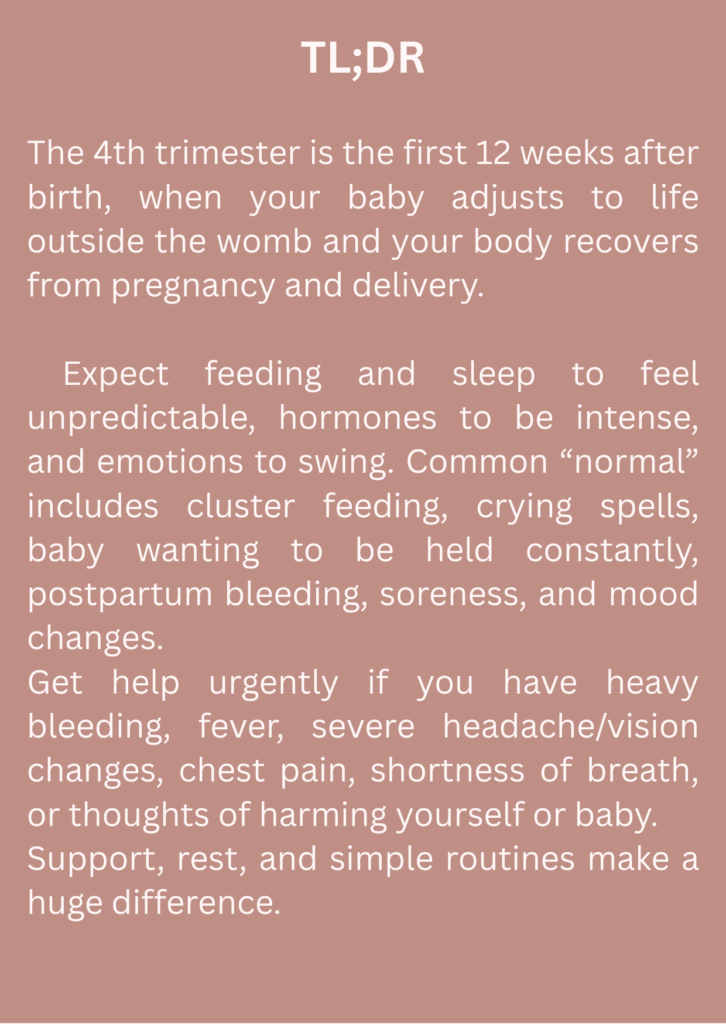
The 4th trimester refers to the first 12 weeks after your baby is born. It’s a transition period — for your newborn, who has gone from warm, dark, and constantly held… to bright lights, digestion, cold air, and unpredictable sensations. And for you, as your body recovers physically, your hormones shift dramatically, and you learn how to care for a baby while healing.
A helpful way to think about it is this: babies are born “early” compared to many other mammals. If humans had a bigger pelvis and babies had smaller heads, newborns could gestate longer. But nature had to compromise. So the 4th trimester becomes a “finishing” season — where your baby still needs womb-like support to feel safe.
And that means the 4th trimester often looks like:
Lots of feeding (sometimes nonstop)
Lots of contact (baby wants to be held constantly)
Lots of crying (for reasons you can’t always fix)
Lots of feelings (for you)
That doesn’t mean you’re doing it wrong. That’s the 4th trimester.

What’s Normal for Baby in the 4th Trimester?
Let’s normalize what’s common — because so many new moms panic simply because nobody warned them.
1) Sleep Is Messy (and That’s Normal)
During the 4th trimester, newborn sleep is not structured. Babies wake often, day and night. Many babies have their days and nights mixed up, and most won’t sleep long stretches at first.
It’s normal for newborns to:
Wake every 2–3 hours (sometimes more)
Nap in short bursts
Sleep better while being held
Get fussy in the evenings (hello, witching hour)
If your baby only sleeps on you, it can feel like you’re doing something wrong — but in the 4th trimester, it’s often a biological need. Your baby is still learning to feel safe in the outside world.
2) Feeding Can Be Constant
Feeding is a full-time job in the 4th trimester — whether you breastfeed, formula feed, or do both.
Common feeding patterns include:
Cluster feeding (feeding frequently for a few hours)
Comfort sucking
Sudden changes in appetite
Fussing at the breast or bottle when tired or gassy
Cluster feeding often makes moms worry they “don’t have enough milk” — but it’s frequently normal newborn behavior and part of how supply establishes in breastfeeding. For formula-fed babies, frequent small feeds can also be normal early on.
3) Crying Has Peaks
Newborn crying often increases in the first weeks and can peak around 6–8 weeks. Many babies have a fussy period in the late afternoon/evening.
This can feel brutal — especially when you’re exhausted — but it’s very common in the 4th trimester. The goal isn’t always to stop crying instantly. Sometimes it’s to support your baby through it.
Helpful soothing tools:
Skin-to-skin contact
Swaddling (if safe and baby isn’t rolling yet)
White noise
Gentle rocking
A warm bath
Movement (walking, baby-wearing)
4) Poop Changes Constantly
In the 4th trimester, newborn poop can change color, consistency, and frequency often. Many babies grunt, strain, and pull faces — even when their stool is soft. This can be normal as their digestive system matures.
But always check with your healthcare provider if you see:
Blood in stool
Very pale/white stools
Signs of dehydration (very few wet nappies, dry mouth, lethargy)

What’s Normal for Mom in the 4th Trimester?
Now for the part that matters just as much: you.
The 4th trimester is postpartum recovery plus identity shift — all at once.
1) Bleeding and Cramping
Postpartum bleeding (lochia) can last for weeks and changes from red to pink/brown to lighter discharge. Cramping (afterpains) is also common, especially while feeding, because your uterus is contracting back down.
Normal can include:
Bleeding that gradually decreases
Mild to moderate cramps
Passing small clots early on
Get checked urgently if:
You soak a pad in an hour or less
You pass large clots (bigger than a golf ball)
Bleeding suddenly becomes heavy again with dizziness or weakness
2) Soreness and Body “Weirdness”
Whether you had a vaginal birth or a C-section, your body has been through a lot. You may feel sore, bruised, swollen, or tender. You may also feel “empty” in your belly, or like your insides shift when you stand up — this can be a normal sensation early on.
Common experiences:
Perineal pain or stitches healing
C-section tenderness and pulling
Back pain from feeding/holding positions
Night sweats (hormones!)
Hair loss later on (usually after a few months)
3) Hormones and Emotional Swings
In the 4th trimester, hormone levels shift dramatically. It can affect mood, sleep, anxiety levels, and how you cope.
Baby blues (very common) can include:
Crying easily
Feeling overwhelmed
Irritability
Mood swings
These typically peak around day 3–5 and improve within 2 weeks.
Postpartum depression or anxiety can look like:
Constant unexplainable rage
Feeling numb or hopeless
Constant worry or panic
Intrusive thoughts
Not sleeping even when baby sleeps
Feeling disconnected from baby
Thoughts of harming yourself or baby
If you feel any of this — especially thoughts of harm — please reach out to a healthcare professional urgently. You are not a bad mom. You are a mom who deserves support.
When to Get Help (Don’t “Wait It Out”)
During the 4th trimester, trust your instincts. Get medical help urgently if you have:
Fever, chills, or flu-like symptoms
Foul-smelling discharge
Severe headache, vision changes, or high blood pressure symptoms
Chest pain, shortness of breath, or leg swelling/pain
Heavy bleeding or faintness
Thoughts of self-harm or harming baby
Your concerns are valid and you deserve to be taken seriously and supported without judgement.

How to Make the 4th Trimester Easier (Practical, Real-Life Tips)
You don’t need a perfect schedule. You need support and a few grounding habits.
Try this:
Lower the standard: Your job is recovery + feeding + bonding.
Make a “survival station”: nappies, wipes, water bottle, snacks, burp cloth, charger.
Eat like it’s your medicine: quick proteins, soups, snacks you can grab one-handed.
- Hydrate, Hydrate, Hydrate!
Get outside once a day: even 5 minutes in fresh air can reset your nervous system.
Accept help without guilt: meals, laundry, holding baby while you shower.
And if you’re in the 4th trimester thinking, “Breastfeeding shouldn’t feel this hard… but it does” — our Breastfeeding Kit was made for you too. It’s a supportive, mom-friendly kit designed to help with the most common early breastfeeding challenges (like painful nipples, engorgement, blocked ducts, milk supply worries, and latch struggles) — so you can feel more confident, more comfortable, and less alone during those tender first weeks.
You’re Not Failing — You’re in the 4th Trimester
The 4th trimester is not a soft, peaceful newborn bubble for most people. It’s intense, tender, exhausting, and deeply transformative. If you’re finding it hard, that doesn’t mean you’re doing it wrong. It means you’re in it.
Go gently. Ask for help sooner. And remember: you don’t need to know everything — you just need the right support, one day at a time.
Looking for calm, nurse-written guidance for those “what now?” moments? Explore our newborn-friendly resources at Mamakit.co.
